Location

Hyderabad

Phone Number

+91 8886223298

Send Your Mail

inforoarengineers@gmail.com

Ultra Filtration Systems


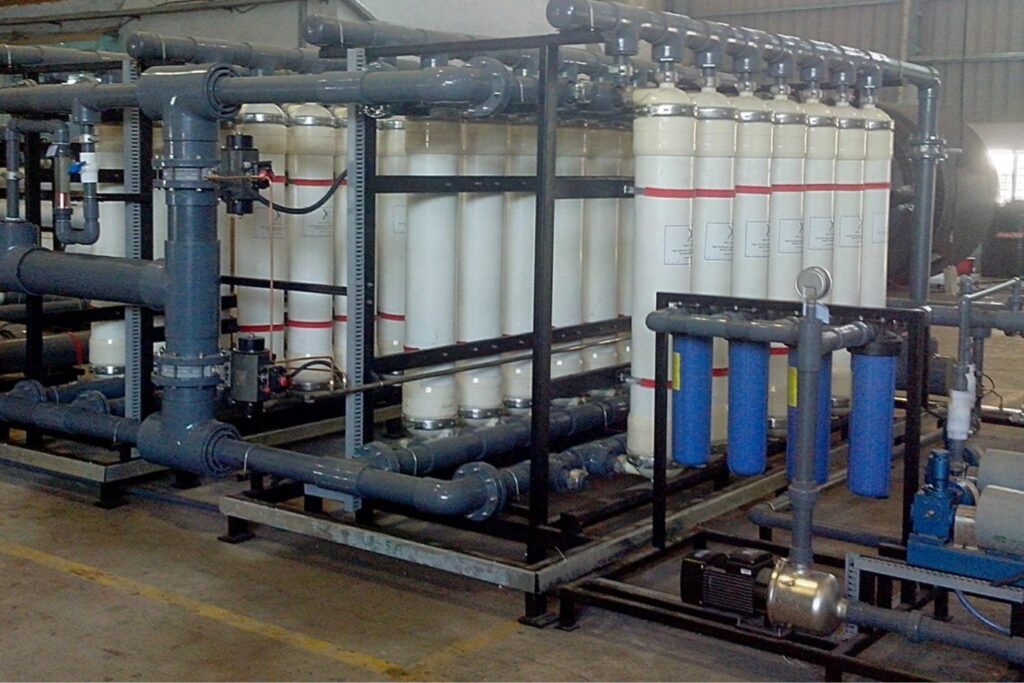
Ultrafiltration (UF) treatment is a separation process using sieving as the separation method. It uses pressure as the driving force to achieve mechanical separation. When the mixed solution containing different sizes of the molecular solute flows through the membrane surface, the solvent and small molecules such as inorganic salts pass through the membrane and the macromolecule solute is trapped to achieve the purpose of separation and purification. Only fresh water and dissolved minerals pass through the membrane.

The DWTPL ultrafiltration plant process involves the removal of particulates and macromolecules from raw water to produce potable water. It assists environmental awareness initiatives and regulations, which help to avert negative environmental impact.

Electrocoagulation (EC) is a revolutionary treatment for wastewater applications. It consists of pairs of metal sheets called electrodes arranged in pairs of two-anodes and cathodes. The cathode is oxidized using the principles of electrochemistry, while the water is reduced (gains electrons), thereby making the wastewater better treated. A direct current is applied to electrodes that are submerged in an aqueous solution. EC is a straightforward and efficient technique to remove the flocculating agent produced by the electro-oxidation of a sacrificial anode and is generally made of iron or aluminium.

DWTPL Electrocoagulation water treatment plant applies is the broad-spectrum technology that removes total suspended solids, emulsified oils, bacteria and other contaminants from water. It is an electrochemical water treatment process that destabilizes and aggregates contaminant particles, ions such as heavy metals, and colloids, using an electrical charge to hold them in solution.

Ultrafilter vs. Conventional Filter:

With intention the best quality of Mineral Water, Ultrafiltration, like reverse osmosis, is a cross-flow separation process. Here liquid stream to be treated (feed) flows tangentially along the membrane surface, thereby producing two streams. The stream of liquid that comes through the membrane is called permeate. The type and amount of species left in the permeate will depend on the characteristics of the membrane, the operating conditions, and the quality of feed. The other liquid stream is called concentrate and gets progressively concentrated in those species removed by the membrane. In cross-flow separation, therefore, the membrane itself does not act as a collector of ions, molecules, or colloids but merely as a barrier to these species.
Conventional filters such as media filters or cartridge filters, on the other hand, only remove suspended solids by trapping these in the pores of the filter-media. These filters therefore act as depositories of suspended solids and have to be cleaned or replaced frequently. Conventional filters are used upstream from the membrane system to remove relatively large suspended solids and to let the membrane do the job of removing fine particles and dissolved solids. In ultrafiltration, for many applications, no prefilters are used and ultrafiltration modules concentrate all of the suspended and emulsified materials.

Feel Free To Contact Us

Ready to Revolutionize Your Water Management?

Let Roar Engineers guide you in overcoming water and environmental management challenges. We, delivers reliable, sustainable, and customized solutions for every need.

Scroll to Top